

Dual Boiler Espresso Machine: Worth the Investment?

Our picks at a glance
You pull a shot that looks great. The crema settles, the aroma is right, and then the morning stalls. Your single boiler needs time to climb from brew temperature to steam temperature, so you stand there with a pitcher of cold milk waiting for the machine to catch up. If you make one flat white a day, maybe that pause is tolerable. If you make two lattes before work, or coffee for guests on weekends, it gets old fast.
That moment is usually what sends people looking at a dual boiler espresso machine. Not because they want café theatre on the counter, but because they want the machine to stop interrupting the workflow. That decision also comes with questions most buying guides skip. What happens to the price once exchange, duties, and local retail markups are involved? Will the machine work on your home's electrical supply without surprises? And which features help with the lighter, fruit-forward coffees many specialty roasters sell?
Dual boilers make sense in some contexts, and not in others. The machine type has real strengths, real costs, and a few ownership headaches that only show up after the box arrives.
The End of Waiting for Your Morning Latte
Not sure which machine is right for you?
TAKE THE QUIZThe biggest advantage of a dual boiler isn't prestige. It's flow.
On a single boiler machine, the routine breaks in half. You brew first. Then you wait. Then you steam. If the timing is off, the milk texture suffers or the shot sits too long. That's manageable for occasional use, but it becomes a daily annoyance for anyone who drinks cappuccinos, flat whites, or lattes regularly.
A dual boiler espresso machine removes that bottleneck by separating the jobs. One boiler stays at brew temperature. The other stays ready for steam. You can pull the shot and texture milk at the same time, which makes the whole process feel less like managing hardware and more like making coffee.
Practical rule: If your main drink includes milk, workflow matters almost as much as shot quality.
That's one reason dual boilers have moved from niche enthusiast gear into the mainstream of specialty coffee. Shops need consistency without pauses, and home users chasing the same café rhythm want the same thing.
When the frustration becomes obvious
You'll notice the limit of a single boiler fastest in three situations:
- Back-to-back milk drinks. Two lattes in a row turn a quick routine into a stop-start process.
- Guests at home. One person wants a cappuccino, another wants a latte, and now you're managing machine recovery instead of serving coffee.
- Lighter roasts. These often reward tighter temperature control, so adding workflow delays on top of precise brewing makes the whole process less forgiving.
For straight espresso drinkers, the upgrade is less urgent. For milk drinkers, it can change the whole experience of using the machine.
How a Dual Boiler Espresso Machine Works
A dual boiler espresso machine is easiest to understand if you think of it as two dedicated hot water systems inside one body. One exists for espresso. The other exists for steam. They share a machine, but they don't share the same thermal job.

Two boilers with two jobs
The brew boiler holds water at a temperature suited to extraction. For most espresso, that means a stable range around the low 90s Celsius. The steam boiler runs much hotter so it can produce dry, strong steam for milk texturing.
Water enters from either a tank or a plumbed line, depending on the machine. From there, the system sends water through the correct path for the task at hand. Brewing water goes to the group. Steam boiler water creates pressure for the steam wand.
That separation matters because espresso and milk steaming want very different conditions. Espresso needs stability and precision. Steam needs heat and pressure. Asking one boiler to do both means compromise. Giving each task its own boiler means each one can stay ready.
Why independence matters in the cup
The practical benefit isn't just speed. It's temperature independence.
On a weaker or simpler machine, steaming can disturb brew conditions. On a dual boiler, the brew side doesn't have to care what the steam side is doing. That makes repeatability easier, especially when you're trying to dial in a coffee over several shots.
A good machine also gives you direct control over brew temperature, usually through a PID controller. That's useful when switching between darker blends and lighter single origins. If a coffee tastes sharp or underdeveloped, you can make a small temperature adjustment without affecting steam readiness.
The best dual boilers feel boring in the right way. You stop compensating for the machine and start paying attention to the coffee.
A few ownership details flow from this design:
- Heat-up can take longer than simple machines because there's more mass to stabilise.
- They're usually larger and heavier than entry-level machines.
- Maintenance matters more because there are more components to keep clean and working properly.
The upside is that once the machine is up to temperature, it stays composed. That's the reason people buy them.
Dual Boiler vs Single Boiler and Heat Exchanger
Not every espresso machine buyer needs a dual boiler. Some people are better served by a single boiler. Others land in the middle with a heat exchanger. The right pick depends less on online hype and more on how you make coffee at home.
Where each system wins
A single boiler is the simplest choice. It works best for people who mostly drink straight espresso, make one drink at a time, and don't mind waiting when milk is involved. It's also the easiest way to spend less and take up less counter space. The trade-off is obvious every time you switch modes.
A heat exchanger machine uses one steam-ready boiler and routes brew water through a heat exchange path. That allows brewing and steaming in the same session, which is why HX machines still appeal to traditionalists. The catch is that they usually ask more from the user. Cooling flushes, learning the machine's rhythm, and managing temperature behaviour are part of ownership.
A dual boiler espresso machine is the cleanest solution for precision plus convenience. It's the easiest platform for repeatable espresso and milk drinks without juggling timing tricks.
Quick comparison table
| Feature | Single Boiler (SB) | Heat Exchanger (HX) | Dual Boiler (DB) |
|---|---|---|---|
| Brew and steam workflow | Sequential | Simultaneous, with more user management | Simultaneous, with the least compromise |
| Brew temperature control | Basic to moderate | Less intuitive in practice | Strong and direct |
| Steam performance | Usually modest | Usually strong | Strong and consistent |
| Learning curve | Lower | Moderate to high | Moderate |
| Best fit | Straight espresso, tighter budgets | Traditional milk drink workflow, users who enjoy managing the machine | Daily milk drinks, precision-focused home baristas |
If you're still unsure whether a more hands-on machine style suits you, it can help to compare boiler systems with other formats such as a lever espresso machine, because the workflow tells you as much as the spec sheet.
HX machines can be excellent. They just ask more from the user. A dual boiler usually asks for more money instead.
The deciding questions are simple:
- Do you make milk drinks often? Dual boiler starts to make sense quickly.
- Do you enjoy learning machine quirks? HX can be rewarding.
- Do you want the machine to disappear into the background? Dual boiler is usually the better answer.
Key Features to Evaluate When Buying
Specs on a product page can look impressive without telling you much about day-to-day use. When I'm assessing a dual boiler espresso machine, I care less about marketing language and more about whether the machine will stay stable, be repairable, and fit the way the owner drinks coffee.

The shortlist that matters
Start with the features that change your results in the cup and your experience at the counter.
- PID temperature control. This is close to non-negotiable on a serious dual boiler. It lets you set and hold brew temperature with intention instead of guessing.
- Independent boiler control. Some machines let you switch the steam boiler off when you're only pulling espresso. That matters if you don't need steam every session.
- Pump type. Rotary pumps are usually quieter and often preferred by people who want a premium feel or plumb-in capability. Vibratory pumps can still make excellent coffee, but they tend to feel less refined.
- Build quality. Stainless steel body panels, solid valves, and clean internal layout matter more than decorative finishes.
- Steam wand performance. Good steam should feel predictable. If milk texturing is a priority, look for a wand and steam circuit that give you control rather than aggression.
A machine can have a long feature list and still miss the mark if those basics aren't well executed.
Serviceability is part of performance
Many buyers encounter a common pitfall. They compare shot features, then ignore repair reality.
A home machine isn't a phone. You're buying something with seals, heating elements, pumps, valves, and electronics that may need service. Machines with common parts, clear internal access, and established support networks are easier to own long term. Machines that look great but are awkward to open or difficult to source parts for become expensive frustrations.
Here's the checklist I'd use before buying:
- Ask who services it in Canada. Local support beats theoretical warranty coverage.
- Check parts availability. Common brands and established models are usually safer than obscure imports.
- Look at layout photos if available. A tidy internal layout often signals easier maintenance.
- Think about your own habits. If you rarely steam milk, paying extra for the most aggressive steam setup may not improve your coffee.
Buying advice: A better machine isn't just one that extracts well. It's one you can still get serviced without drama a few years from now.
Good dual boilers reward careful buyers. The flashy extras matter less than stable fundamentals and practical support.
Understanding Budget Ranges and Trade-Offs
Price jumps fast once you start shopping for a dual boiler espresso machine, and not every jump buys the same kind of improvement. Some increases pay for convenience and build. Others mostly pay for finish, brand cachet, or niche features you may never use.

What changes as the price climbs
At the lower end of the dual boiler category, you're usually buying the core benefit first. Separate brew and steam boilers, PID control, and solid espresso potential. The compromises often show up in pump noise, fit and finish, user interface, and long-term refinement.
Mid-range machines tend to be the sweet spot for many home baristas. At this level, build quality improves, controls feel better, and steam performance often becomes more polished. If you make coffee daily, this tier often feels easier to live with.
At the higher end, the gains become more personal than universal. You may get quieter operation, better materials, pressure profiling, plumb-in options, or more polished internals. Those features can be worth paying for, but only if they solve a real problem in your routine.
If you're comparing across categories and trying to match budget to habit, this guide to the best espresso machine for your home is useful because it keeps the decision tied to actual use rather than prestige.
A quick visual can help frame what changes across tiers:
Spend for your routine, not for bragging rights
The biggest mistake I see is buying for the fantasy version of home espresso. People imagine hosting brunch every weekend, profiling every shot, and steaming five milk drinks in a row. In reality, they make one cappuccino each morning.
That doesn't mean you shouldn't buy a premium machine. It means you should know why.
- If speed is the pain point, almost any competent dual boiler will feel like a major upgrade.
- If you chase lighter roasts and subtle flavour differences, temperature control and adjustability matter more.
- If noise, finish, and tactile quality matter, higher-end machines justify themselves in daily use more than in cup quality alone.
A more expensive machine can be worth it. It just isn't automatically better for every buyer.
Five Dual Boilers Worth Buying in Canada
Everything above is about how dual boilers work. These five are machines a Canadian can actually buy, at five different prices. All of them brew and steam at the same time, which is the whole point of the second boiler. What separates them is what you get on top of that.
Best entry-level: Breville Dual Boiler
This is the least expensive machine on the page, and the one that tells you the most while you are learning. A gauge reads the pressure as the shot runs and a clock counts the seconds, so a shot that poured too fast leaves evidence behind. The group head is the 58 millimetre size cafes use, brew temperature is held by a PID controller, and single and double shot volumes can be programmed once you know what you want.
There is no grinder built in, so budget for one, and the milk is textured by hand. It runs from its own tank with no plumb-in option, and there is no flow control, so what you adjust is temperature, pre-infusion and volume rather than the shape of the shot itself. For a dual boiler machine with the grinder and two scales built in, see our Meraki espresso machine review.
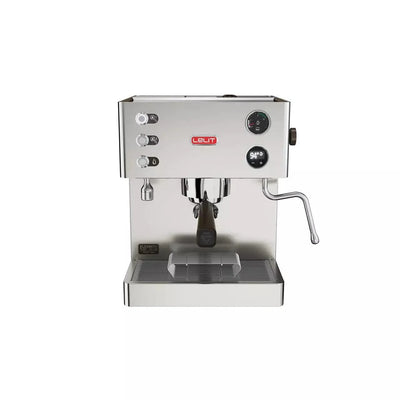
Best value dual boiler: Lelit Elizabeth
The Elizabeth is the least expensive of the Italian machines here. Its group head, the part the portafilter locks into, is the 58 millimetre size cafes use, so baskets and tampers bought later will fit. A backlit gauge shows the pressure while the shot is running, which is the quickest way to see that something has gone wrong.
It has no flow control, so you cannot vary the water flow by hand partway through a shot. Programming runs through a small display: fine once you have learned it, fiddly before that.
Best compact dual boiler: Profitec MOVE
The MOVE fits two boilers into a small case, so you get simultaneous brewing and steaming without handing over the counter. A fast heat-up mode gets it going quickly, and you can set the times it switches itself on and off, so it is warm before you are up.
It uses a vibration pump rather than the quieter rotary type used further up, and the display is small for the number of things it controls. A bottomless portafilter and three baskets come in the box.
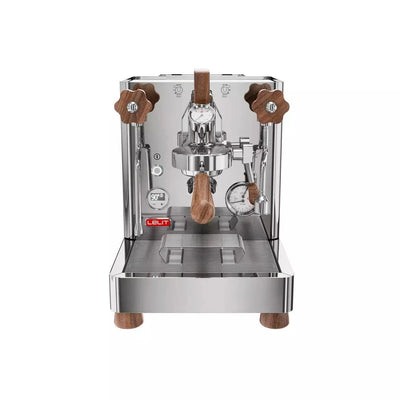
Best with flow control: Lelit Bianca
The wooden paddle on top is what you are paying for. It controls water flow by hand during the shot, so you can start gently and open up as the coffee runs, which is how you rescue a shot that would otherwise pour too fast. Two boilers mean steam is ready whenever you are.
Flow control rewards practice before it helps, so expect a stretch where the paddle makes shots worse rather than better. The E61 group, a heavy brass assembly that holds its temperature well, needs about twenty minutes to come up to heat.
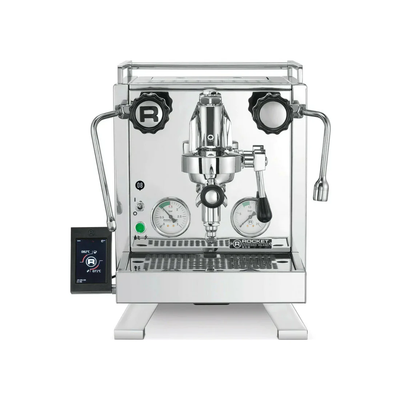
Best plumbed-in: Rocket R58 Cinquantotto
The R58 sets espresso and steam temperatures separately, so you can move the brew temperature to bring out different flavours in a coffee without touching the steam. It runs from its own tank or plumbed straight into the water line, and its rotary pump is quieter than the vibration pumps below it.
It takes about twenty minutes to reach temperature and weighs sixty-four pounds, so it goes where you put it and stays there.
A Canadian's Guide to Buying and Ownership
Most dual boiler buying advice is written with US pricing, US power assumptions, and US service options in mind. That's where Canadian buyers get caught. The machine may be the same, but the ownership experience isn't.
The price tag is not the full price
A machine that looks reasonably priced in a US review can land very differently here.
Local pricing and voltage decide whether the “deal” you saw in a foreign review is actually a deal once it reaches your kitchen.
Here's what I'd check before ordering:
- Voltage requirements. Don't assume a machine discussed in a US review matches the Canadian version.
- Local electrical reality. If the machine needs a dedicated higher-voltage setup, budget for an electrician from the start.
- Who handles warranty work. Cross-border warranty support can become a headache fast.
- Shipping and brokerage. These aren't minor details on a heavy machine.
Buy for support, not just specs
A dual boiler is a long-term purchase. That shifts the priority away from launch-day excitement and toward practical ownership.
Canadian buyers should strongly prefer machines with local dealer support, local parts access, and a clear service path. Saving money up front can look smart until you need a valve, a control board, or warranty work and realise the machine has to cross a border to be dealt with.
The best Canadian buying strategy is simple. Pay attention to where the machine will be serviced before you fall in love with how it looks on a counter.
That one habit saves more frustration than obsessing over minor feature differences.
Mastering Your Dual Boiler for Better Coffee
Buying the machine is the easy part. Making it taste better than your old setup takes a bit of discipline.
Dial in for Canadian light roasts
Many newer dual boiler machines now include presets for drinks like Espresso Shakerato. The useful part for home baristas is less the preset itself and more the reminder that modern machines can do more than traditional hot espresso.
For lighter-roast Canadian beans, presets often get you close but not all the way there. Stable hardware helps, but the coffee still needs to be dialled in properly.
If grind is the variable you're fighting most, this guide on how to grind coffee beans is worth keeping nearby.
Habits that keep the machine working well
A dual boiler rewards routine.
- Backflush regularly. Coffee oils build up quickly and affect flavour.
- Use good water. Scale and mineral issues are expensive on more complex machines.
- Change one variable at a time. If the shot tastes wrong, don't adjust dose, grind, and temperature all at once.
- Steam with intention. Stronger steam means small mistakes in milk positioning show up faster.
Start with a sensible recipe, keep notes for a few sessions, and let the machine's stability work in your favour.
That's when a dual boiler starts to feel less like a gadget and more like a dependable tool.
Frequently Asked Questions
Can you plumb in a dual boiler espresso machine at home
Some models allow it, some don't. Plumb-in capability is worth considering if you make a lot of drinks or dislike filling a reservoir, but it also adds complexity. Before buying, check whether the machine is designed for direct water connection and whether local installation is practical in your kitchen.
Will a dual boiler raise electricity use
Usually, yes. You're maintaining more heated mass than on a simpler machine. In practice, the impact depends on how long you leave the machine on and whether you use features like scheduled warm-up or turn the steam boiler off when you don't need it.
Is a dual boiler overkill if you mostly drink straight espresso
Sometimes, yes. If you almost never steam milk, the strongest reason to buy a dual boiler becomes temperature control and convenience rather than simultaneous operation. For some straight espresso drinkers, a simpler machine can be the better value. For others, the stability and easier workflow still justify the upgrade.
Should Canadian buyers avoid ordering from outside Canada
Not always, but you should be cautious. Cross-border savings can disappear once exchange, shipping, duties, brokerage, electrical work, and warranty logistics are factored in.
If you've invested in great espresso gear, the coffee going into the portafilter matters just as much. Stillwater Coffee Club helps Canadians discover fresh beans from top specialty roasters across the country, so your dual boiler espresso machine has coffee worthy of the upgrade.
Related guides
Compare every pick
| Model | Price | Boiler | Plumbable |
|---|---|---|---|
| Breville Dual Boiler Buy from AmazonBuy from Amazon | $2,399.99 $1,599.95 | Dual boiler, stainless steel | No |
| Lelit Elizabeth | $2,695.00 $1,799.95 | Dual boiler | No |
| Profitec MOVE Buy from Coffee AddictsBuy from Clive Coffee | $3,149.00 $2,199.00 | Dual boiler | No |
| Lelit Bianca | $4,595.00 $2,999.95 | Dual boiler | Yes |
| Rocket R58 Cinquantotto | $4,995.00 — | Dual, 0.58 L brew and 1.7 L steam | Yes |
The picks in full

Best entry-level
Breville Dual Boiler
What's good
- Brew and steam at the same time, with no waiting
- 58 mm portafilter, the commercial size
- Brew temperature held by PID control
What to know
- No built-in grinder, so budget for one
- Milk is textured by hand, with no automatic setting
Where to buy
Buy from AmazonWhere to buy
Buy from Amazon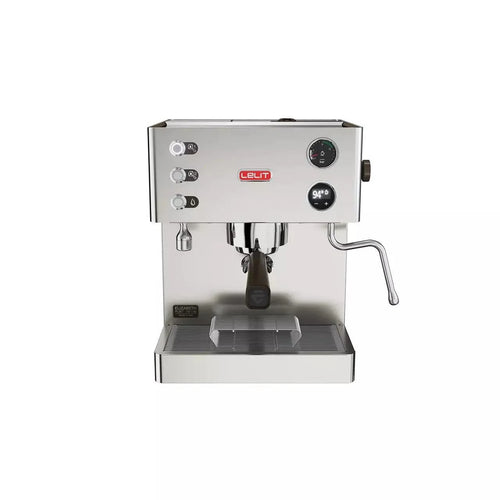
Best value dual boiler
Lelit Elizabeth
What's good
- Two boilers, so no waiting between shot and steam
- 58 mm commercial group head
- Backlit gauge shows pressure as you brew
What to know
- No flow control during the shot
- Programming runs through a small display

Best compact dual boiler
Profitec MOVE
What's good
- Two boilers in a compact case
- Programmable on and off times
- Bottomless portafilter and three baskets included
What to know
- Small display for the amount it controls
- Vibration pump, not the quieter rotary type
Where to buy
$3,149 from Coffee AddictsWhere to buy
$2,199 from Clive Coffee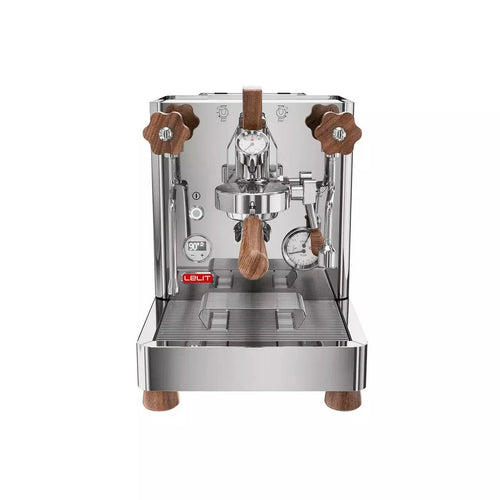
Best with flow control
Lelit Bianca
What's good
- Paddle controls water flow during the shot
- Two boilers, so steam is always ready
- Programmable pre-infusion at steady pressure
What to know
- Flow control rewards practice before it helps
- E61 group needs 20 to 30 minutes to heat

Best plumbed-in
Rocket R58 Cinquantotto
What's good
- Espresso and steam temperatures set separately
- Runs from a tank or plumbed into the water line
- Rotary pump, quieter than a vibration pump
What to know
- About 20 minutes to reach temperature
- 64 pounds, so it does not move once placed