

Best Super Automatic Espresso Machine for 2026

This is our guide to the best super automatic espresso machine for 2026. A super-automatic grinds whole beans, brews the shot and, on most models, froths the milk at the press of a button. The guide is for someone who orders espresso, americanos or lattes at a cafe and wants the same drinks at home with as little work as possible. Owners notice two differences between these machines every day: how strong the straight espresso tastes, and how long the milk system takes to clean. The picks are sorted by the drinks you make, what you want to spend and the space on your counter.
Our picks at a glance



The drinks you make and the space you have decide which machine to buy
A super-automatic froths milk in one of two ways. Some have a steam wand, a metal tube that blows steam into a jug of milk you hold under it. Others draw milk from a carafe or container and pour the finished drink for you.
| How you drink coffee | The machine to buy |
|---|---|
| Strong espresso and a cappuccino now and then, for years | Jura E6 |
| Espresso and americanos, with a latte you froth yourself now and then | De'Longhi Magnifica Evo |
| A long menu of one-touch milk drinks, with a strong espresso | De'Longhi Magnifica Plus |
| De'Longhi espresso for the least money | De'Longhi Magnifica Start |
| A latte or cappuccino most mornings, cleaned up quickly | Philips 3300 LatteGo |
| A regular coffee and a decaf, swapped on as you need them | De'Longhi Rivelia |
| A low gap under the kitchen cabinets | Gaggia Brera |
| A regular coffee and a decaf both loaded, or blended, at one touch | Jura GIGA 10 |
As of October 2026, the Magnifica Evo's regular price is under $1,000 and the Magnifica Plus's is under $1,500, in Canada and the US. Each card shows the price in your own currency.
Best overall: Jura E6
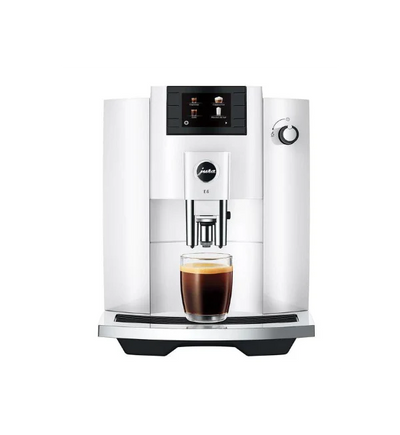
The Jura E6 is the best overall pick because owners who tried the E6 beside other super-automatics most often found its espresso stronger, and ten owners report five years or more of daily use. The machines in those side-by-side reports include a De'Longhi Magnifica, a KitchenAid KF7 and a De'Longhi Eletta Explore. One of the long-running E6s made more than 28,000 cups over seven years for a family of heavy coffee drinkers.
The E6 suits someone who wants the machine to grind and brew an espresso or americano at one press and is happy to turn a switch for the milk in a cappuccino. Those long-running reports describe the E6 sold before 2022. The Jura E6 review covers the machine in full, and Jura E6 vs E8 explains what the E8 adds.
Best under $1,000: De'Longhi Magnifica Evo
In buying-advice threads, people name the Magnifica Evo more often than any other machine under $1,000, and the reason they give is the espresso. About 25 owners who have used both brands say a De'Longhi shot tastes stronger and fuller than a Philips. De'Longhi's Magnifica line also has a long record: owners report older Magnificas running 8 to 15 years, and owners of the current Evo report one to three years of trouble-free use so far.
The Evo suits someone who mostly drinks espresso and americanos and steams milk for the occasional latte. For milk drinks at one touch from the same De'Longhi espresso, the Magnifica Plus is the next step up.
Best under $1,500: De'Longhi Magnifica Plus
The Magnifica Plus puts a touchscreen and one-touch milk drinks on the same De'Longhi espresso, and about 20 people in buying-advice threads name it as their pick when it is on sale. One owner who had owned a Philips 3200 and then a 5500 called it a "much better machine, better coffee, better foam."
Owners report 600 to 1,300 trouble-free drinks in the first year. One owner returned a machine that left wet, soggy grounds at every setting, and another owner's machine failed at eight months. Five owners of De'Longhi carafe machines report the milk foam going thin, from three weeks to three years in. One traced it to dried milk inside the carafe, so rinse the carafe after each milk drink.
Best budget super-automatic: De'Longhi Magnifica Start
The Magnifica Start is the budget pick because it brings the Magnifica line's espresso to the lowest price. Owners say the Start has the same brew unit, the part that presses and brews the coffee, and the same grinder as the Magnifica Evo, so the Evo's extra money buys three more one-touch drinks. About 15 owners report being happy with the Start, one of them at three years, and one who returned a Philips 800 for it says the same beans tasted much better.
A few owners find the Start's espresso too weak, and a few say the same of its long coffee, the bigger, milder cup from the "coffee" button. Pressing the espresso button twice into one cup makes a stronger drink. As of October 2026, the Start costs less than the Gaggia Brera in Canada, and the Brera costs less in the US.
Best for lattes: Philips 3300 LatteGo
The 3300 is the machine to buy if most of your coffees have milk in them. Owners widely call the LatteGo milk container the easiest automatic milk system to clean, including owners who have also had a De'Longhi carafe, and that matters on a machine you use for milk every day.
The trade-off owners raise most often is the espresso: about 22 owners find a straight shot from a Philips weak or watery, while others say it improves once the grind is set finer and the temperature is set to high. Some Philips owners also report leaks, or a broken grinder chute, the plastic channel that carries ground coffee to the brew unit, within four years. Most of those reports describe the 3200, which the 3300 replaced with the same body, grinder and LatteGo container.
If you would rather pour milk from a carafe, the Gaggia Cadorna Prestige has the longest owner reports among the carafe machines here. Two owners report three to four years and more than 4,000 drinks each, and one reports "Zero issues."
Best for regular and decaf: De'Longhi Rivelia
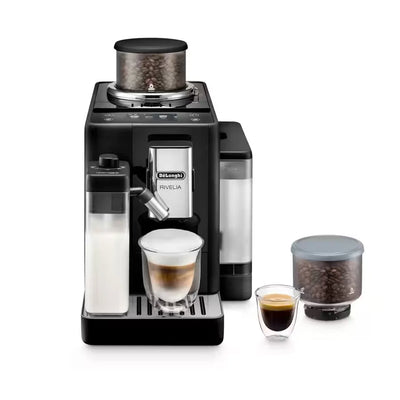
One owner who moved to the Rivelia from a Philips says it makes a much better americano. Another, who had owned several Gaggias, says the coffee is a bit better and the machine easier to maintain. The Rivelia suits a house that drinks a regular coffee and a decaf: one bean hopper sits on the grinder at a time, and to switch coffees you lift it off and set the other in its place.
The Rivelia reached the US in 2025, so owner reports so far cover its first year or two. For both coffees on the machine at once, the Jura GIGA 10 keeps two bean hoppers and two grinders. De'Longhi Rivelia vs Philips 5500 vs De'Longhi Eletta Explore compares the Rivelia with two other milk-drink machines.
Best for low cabinets: Gaggia Brera
The Brera is the shortest machine on this page at 31.5 cm (12.4 in), about 4 cm lower than the Magnifica Start and the Jura E6, so it leaves the most room to lift the bean hopper lid under low wall cabinets. If counter width is the tighter limit, the Magnifica Start is the narrowest machine here at 23.5 cm (9.25 in) and takes up the least counter area.
Owners report Breras running seven years and longer, and one past 14. About five owners report leaks, some of them on more than one Brera. Two owners find the espresso weak even at the finest grind, and an owner of the Gaggia Anima, which uses the same parts, says the same. Owners put the weak espresso down to the roughly 11 g of coffee the Brera's brew unit holds per shot.
Best splurge: Jura GIGA 10
About nine owners say the two grinders are the reason they bought the GIGA 10, most of them to keep a decaf ready beside their regular coffee. Owners who have used both machines say the GIGA 10 makes the same coffee as the single-grinder Jura Z10, so the second bean hopper and grinder are what the extra money buys.
The Jura GIGA 10 review and the Jura Z10 review cover both machines in full.
Two espresso shots in one cup and the high temperature setting make stronger, hotter drinks
Most super-automatics use less coffee per shot than a cafe double, so a large drink made with the long "coffee" button can taste thin. Owners get a stronger latte or americano by pressing the espresso button twice into the same cup, then adding milk or hot water. Owners of automatic milk systems also measure their drinks coming out cooler than a cafe serves them, roughly 46 to 68°C (115 to 155°F) depending on the machine. Set the brew temperature to high and warm the cup with hot water first, and on a steam wand, steam the milk a little longer.
De'Longhi, Philips and Gaggia brew units lift out for a weekly rinse, and Jura cleans its own with a tablet
On the De'Longhi, Philips and Gaggia machines here the brew unit lifts out, and owners rinse it under the tap once a week, because owners who skipped this report mould growing inside. The Philips and Gaggia brew units also need a little food-safe grease every few hundred shots. Jura's brew unit stays inside the machine, which runs a cleaning cycle with a Jura tablet when the screen asks. The De'Longhi, Philips and Gaggia machines also ask to be descaled, a cleaning cycle that dissolves the mineral scale hard water leaves in the heater, and a water filter in the tank stretches the time between descales. On the Jura machines, the water filter replaces descaling, and the screen asks for a new filter instead.
Coffee roasted in the past few weeks makes a fuller espresso from a built-in grinder
A super-automatic grinds the beans you pour in, so the beans decide the taste of every cup. Coffee roasted in the past few weeks makes a fuller shot with more crema, the tan foam on top. Medium roasts also suit these grinders, because very dark, oily beans can stick in the bean hopper and leave a film inside the grinder. The best coffee beans for a super automatic espresso machine names coffees that work well. Stillwater Coffee Club ships freshly roasted whole beans from independent Canadian roasters every month, and the coffee quiz matches them to the flavours you like.
The Jura E8 adds one-touch milk drinks to the E6's espresso, and the S8 adds a touchscreen
The Jura E8 review covers the machine that makes a latte macchiato and a flat white at one touch, and Jura E8 vs S8 explains what the S8's touchscreen adds. Which Jura coffee machine is right for you walks through the whole lineup, and Terra Kaffe vs Jura compares Jura with an app-controlled rival.
For the other brands here, see which De'Longhi espresso machine and which Gaggia espresso machine. The best home espresso machine compares super-automatics with machines you run by hand, and the best office coffee machine covers machines for a workplace.
Frequently asked questions
What is the best super automatic espresso machine?
The Jura E6 is the best overall, because owners who tried it beside other super-automatics most often found its espresso stronger, and ten owners report five years or more of daily use. Under $1,000, the De'Longhi Magnifica Evo is the machine people name most often in buying-advice threads.
Which super-automatic espresso machine is the most reliable?
Jura and De'Longhi have the longest records in owner reports: ten owners report five years or more from the Jura E6 sold before 2022, and owners report older De'Longhi Magnifica models running 8 to 15 years. A weekly brew-unit rinse or cleaning cycle and regular descaling keep any of these machines running longer.
How long does a super-automatic espresso machine last?
Owners commonly report two to six years from a Philips, seven years or more from a Gaggia Brera, and five to ten years or more from a Jura or a De'Longhi Magnifica, with regular cleaning and descaling. Owners who repair their own machines report that common parts, such as seals and the grinder chute, cost little.
What is the difference between an automatic and a super-automatic espresso machine?
A super-automatic grinds the beans, measures and presses the coffee, brews the shot and, on most models, froths the milk at one press. Shops also sell these machines as "fully automatic" or "bean-to-cup". An automatic espresso machine stops the shot by itself at a set volume, and you grind the coffee and press it into the basket yourself.
Do super-automatic machines make real espresso?
Yes. A super-automatic grinds fresh beans and pushes water through them at espresso pressure, the same way a cafe machine does. Most use less coffee per shot than a cafe double, so the shot tastes milder, and pressing the espresso button twice makes a stronger drink.
Every machine on this page grinds the beans you load, so the beans set the taste of each cup
A Stillwater subscription matches you with coffee from Canadian roasters, roasted fresh and shipped every month.
Get coffee from a different Canadian roaster every month
Stillwater Coffee Club sends whole-bean coffee from independent Canadian roasters, chosen to match the flavours you pick in our quiz. Plans start at $45.60 a month for two 300 g bags, shipping is free, and you can pause or cancel at any time. Learn more about our coffee subscription →
Compare every pick
| Model | Price | Built-in grinder | Milk |
|---|---|---|---|
| Jura E6 | $2,095.00 $1,899.00 | Yes, conical steel burrs | One-touch cappuccino, front switch for the milk |
| De'Longhi Magnifica Evo | $649.99 — | Yes, conical burr, 13 settings | Manual steam wand |
| De'Longhi Magnifica Plus | $1,199.99 — | Yes, conical, 13 settings | Automatic milk carafe (LatteCrema) |
| De'Longhi Magnifica Start | $699.99 — | Yes, 13 settings | Manual steam wand |
| Philips 3300 LatteGo Buy from AmazonBuy from Amazon | $999.00 $899.99 | Yes, ceramic burrs, 12 settings | Automatic milk container (LatteGo) |
| De'Longhi Rivelia | $1,699.99 — | Yes, burr, 13 settings | Automatic milk carafe, hot |
| Gaggia Brera Buy from AmazonBuy from Amazon | $849.00 $499.00 | Yes, ceramic, five settings | Steam wand (Pannarello), frothed by hand |
| Jura GIGA 10 | $6,995.00 — | Two ceramic grinders, one per bean container | Automatic, from one spout with the coffee |
The picks in full
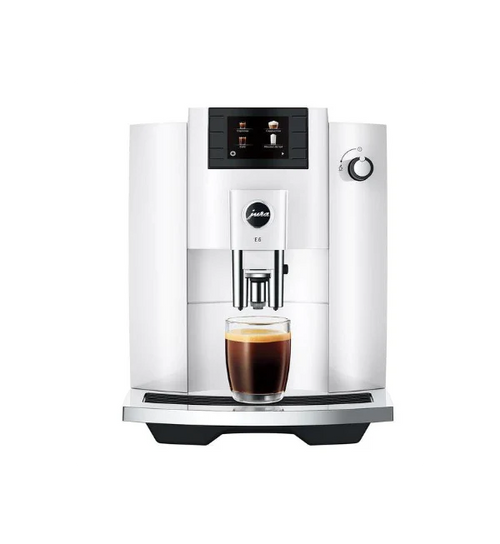
Best overall
Jura E6
What's good
- Up to 16 g of coffee per cup for a strong espresso
- Ten strength settings and three brew temperatures
- Funnel for pre-ground coffee, such as decaf
What to know
- Milk drinks need a turn of the front switch
- Frother needs a cleaning-liquid rinse each day you use milk
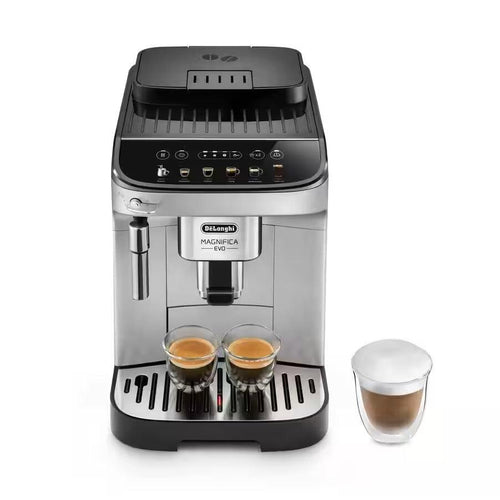
Best under $1,000
De'Longhi Magnifica Evo
What's good
- Six one-press drinks from whole beans
- 13 grind settings for different beans
- Milk wand works with milk substitutes
What to know
- You froth the milk yourself on the wand
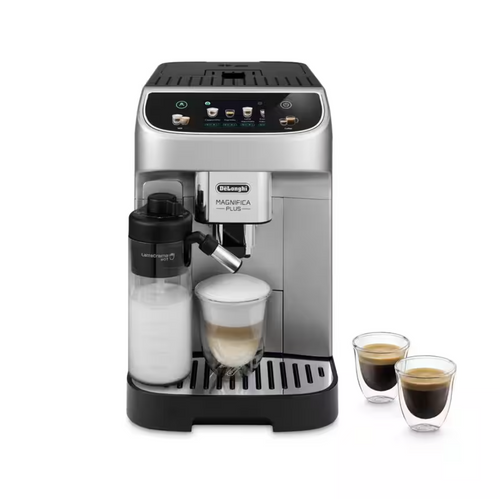
Best under $1,500
De'Longhi Magnifica Plus
What's good
- 18 one-touch drinks on a touchscreen
- Three foam settings, for dairy or plant milk
- Four user profiles save each person's drinks
What to know
- One 250 g bean hopper; a second coffee goes in the pre-ground chute
- 44.5 cm deep, so it needs a deep counter

Best budget super-automatic
De'Longhi Magnifica Start
What's good
- Grinds whole beans fresh for every cup
- Three one-press drinks, with adjustable strength
- Separate chute for pre-ground coffee, such as decaf
What to know
- You steam milk yourself on the wand
- 44 cm deep and 9 kg, so it needs counter space

Best for lattes
Philips 3300 LatteGo
What's good
- Milk container is two parts, both dishwasher safe
- Twelve grind settings on ceramic grinding discs
- Iced coffee is one of the one-touch drinks
What to know
- Milk container holds 260 ml of milk
- Brew unit needs a little grease every few hundred cups
Where to buy
Buy from AmazonWhere to buy
Buy from Amazon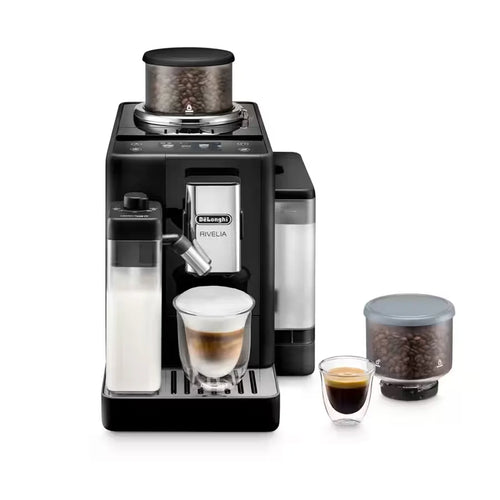
Best for regular and decaf
De'Longhi Rivelia
What's good
- Two bean hoppers that swap in seconds
- 18 one-touch drinks, milk drinks from a carafe
- Saves grind, dose and temperature per bean, De'Longhi says
What to know
- Spare bean containers cost extra
- Touchscreen menus take some learning

Best for low cabinets
Gaggia Brera
What's good
- Water tank and grounds drawer open from the front
- Brew unit lifts out for rinsing under a tap
- Bypass chute for pre-ground coffee, such as decaf
What to know
- Grind adjusts in five steps, so there is less room to fine-tune a shot
- Tank holds 1.2 litres, about six mugs of water
Where to buy
Buy from AmazonWhere to buy
Buy from Amazon
Best splurge
Jura GIGA 10
What's good
- Keeps regular and decaf loaded at once
- Blends the two coffees in 25% steps
- Switches itself on and off on a schedule
What to know
- Drink sizes run XS to XXL, with a chart for millilitres
- Lattes come out at about 55°C